
About RSC 2026
The Reliable and Secure Computing (RSC 2026) will be held on December 11-13, 2026 in Chengdu, organized by University of Electronic Science and Technology of China, China. RSC 2026 is designed to address the growing global demand for resilient, dependable, and secure computing in the era of digital transformation and artificial intelligence. The conference aims to bring together leading researchers, industry professionals, and practitioners from different countries to share cutting-edge findings, foster international collaboration, and shape future research directions. By creating a focused venue for high-quality scholarly exchange, the conference seeks to enhance academic visibility, promote interdisciplinary innovation, and strengthen the international impact of research in reliable and secure computing.
Organized by:
University of Electronic Science and Technology of China, China
TBD
Call For Papers
Authors are invited to submit original, unpublished papers on topics including, but not limited to:
-
Reliable Computing
- Fault-tolerant computing systems
- Dependable distributed and cloud systems
- High-assurance system design
- Resilient architectures and infrastructures
- Reliability modeling, analysis, and evaluation
- Software reliability and testing
- Formal methods for reliability assurance
- Real-time and embedded system dependability
-
Secure Computing
- System and network security
- Applied cryptography and protocols
- Authentication, access control, and identity management
- Privacy-preserving technologies
- Secure software engineering
- Trusted execution environments
- Hardware security and trust
- Security for cloud, edge, and IoT systems
-
Artificial Intelligence and Trustworthy Systems
- Security and reliability of AI systems
- Trustworthy and explainable AI
- Adversarial machine learning
- AI for cybersecurity and system resilience
- Safety, robustness, and verification of intelligent systems
- Privacy and fairness in AI-driven applications
-
Emerging Applications and Interdisciplinary Research
- Secure and reliable cyber-physical systems
- Critical infrastructure protection
- Blockchain and decentralized trust systems
- Secure communications and networking
- Digital forensics and incident response
- Dependability and security in smart cities, healthcare, and transportation
- Human-centered security and usable privacy
- Industrial case studies and real-world deployments
Submission Guidelines
Authors are invited to submit original research papers formatted according to the Springer LNCS/CCIS one-column proceedings style. Please refer to Springer’s Instructions for Authors of Proceedings and use either the LaTeX or Word templates available on the authors’ page when preparing your manuscript. Submission Categories are as follows:
Submission Categories
- Full papers:at least 12 pages, with a recommended length of 12–15 pages
- Short papers: preliminary but mature research results, no less than 6 pages
- Poster papers (optional): work-in-progress, demos, or emerging ideas, no less than 6 pages
Submissions to RSC 2026 must not substantially duplicate work that has already been published or is simultaneously under review at another conference with proceedings or at any journal. RSC 2026 follows a double-blind review process. Manuscripts should not include author names, affiliations, acknowledgements, or other identifying information.
Code of Conduct
All authors are required to adhere to Springer Nature's Code of Conduct for book authors.
Important Dates
| Important Dates | ||
|---|---|---|
| First Round | Paper Submission | July 15, 2026 |
| Acceptance Notification | August 15, 2026 | |
| Second Round | Paper submission | August 30, 2026 |
| Acceptance Notification | September 30, 2026 | |
| Camera-ready Version | October 15, 2026 | |
Organising Committee
Honorary Co-Chairs
Zhiguang Qin, University of Electronic Science and Technology of China, China
General Co-Chairs
Chien-Ming Chen, Nanjing University of Information Science and Technology, China
Guobin Zhu, Vice Dean of the School of Software, University of Electronic Science and Technology of China, China
Technical Program Co-Chairs
Hu Xiong, University of Electronic Science and Technology of China, China
Kuo-Hui Yeh, National Yang Ming Chiao Tung University, Taiwan
Local Arrangement Co-Chairs
Erqiang Zhou, University of Electronic Science and Technology of China, China
Jingxue Chen, Nankai University, China
Publication Chair
Fuhu Deng, University of Electronic Science and Technology of China, China
Yangyang Bao, Peng Cheng Laboratory, China
Publicity Co-Chairs
Weizhi Meng, Lancaster University, United Kingdom
Chunhua Su, University of Aizu, Japan
Yong Xiang, Deakin University, Australia
Yingjiu Li, University of Oregon, US
Zhen Ling, Southeast University, China
Minghao Yang, Southwest Petroleum University, China
Yanan Chen, Jiangxi University of Science and Technology, China
Program Committee
Weizheng Wang, City University of Hong Kong, Hong Kong
Chien-Ming Chen, Nanjing University of Information Science and Technology, China
Mohammed Atiquzzaman, University of Oklahoma, United States
Xuyun Nie, University of Electronic Science and Technology of China, China
Zhe Liu, Zhejiang Lab, China
Liming Fang, Zhejiang, China
Fuhu Deng, University of Electronic Science and Technology of China, China
Weizhi Meng, Lancaster University, United Kingdom
Han-Chieh Chao, Fo Guang University, Taiwan
Yong Xiang, Deakin University, Australia
Yingjiu Li, University of Oregon, US
Zhen Ling, Southeast University, China
Ye Xia, Univesity of Electronic Science and Technology of China, China
Zengxiang Wang, Univesity of Electronic Science and Technology of China, China
Jiafei Wu, University of Aizu, Japan
Dequan Xu, Guizhou University, China
Tsu-Yang Wu, Nanjing University of Information Science and Technology, China
Nathan Clarke, University of Plymouth, United Kingdom
Sabrina De Capitani di Vimercati, Milan University, Italy
Mariki Eloff, University of South Africa, South Africa
Simone Fischer-Hubner, Karlstad University, Sweden
Francesco Flammini, Malardalen University, Sweden
Sara Foresti, Milan University, Italy
Steven Furnell, University of Nottingham, United Kingdom
Bela Genge, Petru Maior University, Romania
Dieter Gollmann, Hamburg University of Technology, Germany
Dong Seong Kim, National Institute of Technology, Australia
Panos Kotzanikolaou, University of Piraeus, Greece
Javier Lopez, University of Malaga, Spain
Eric Luiijf, TNO, the Netherlands
Michail Maniatakos, New York University, United States
Ioannis Mavridis, University of Macedonia, Greece
Haralambos Mouratidis, University of Essex, United Kingdom
Alexios Mylonas, Staffordshire University, United Kingdom
Maria Papadaki, University of Derby, United Kingdom
Nikolaos Pitropakis, Edinburgh Napier University, United Kingdom
Kim-Kwang Raymond Choo, University of Texas at San Antonio, United States
Rodrigo Roman-Castro, University of Malaga, Spain
Pierangela Samarati, University of Milan, Italy
Yannis Stamatiou, University of Patras, Greece
George Stergiopoulos, University of the Aegean, Greece
Willy Susilo, University of Wollongong, Australia
Manos Vasilomanolakis, Aalborg University, Denmark
Edgar Weippl, University of Vienna, Austria
Monica Whitty, University of New South Wales, Australia
Stefano Zanero, Polytechnic of Milan, Italy
Chunhua Su, University of Aizu, Japan
Kuo-Hui Yeh, National Dong Hwa University, Taiwan
Bela Genge, University of Medicine, Pharmacy, Sciences and Technology of Targu Mures, Romania
Emmanouil Vasilomanolakis, Aalborg University, Denmark
Panayiotis Kotzanikolaou, University of Piraeus, Greece
Seong Kim Kumoh, National Institute of Technology, South Korea
Special Issues
As part of the publication plan, RSC 2026 will apply for discounted article processing charges (APCs) for extended versions of selected manuscripts recommended to Special Issues in open access journals.
- AI Security and Safety in Computational Social Systems, IEEE Transaction on Computational Social Systems.
- Selected Papers: The 20th International Conference on Information Security Practice and Experience (RSC 2026), Symmetry.
- Challenges and Solutions in Large Language Models, Joint Journals.
- Emerging Technologies with Symmetry for Zero Trust, Symmetry.
- Information and Future Internet Security, Trust and Privacy—3rd Edition, Future Internet.
- Advanced Vehicular Ad Hoc Networks: 2nd Edition, Sensors.
- Recent Advances in Data Privacy, Transparency and Cybersecurity: Theory and Applications, Applied Science.
- Heuristic Algorithms for Optimizing Network Technologies: Innovations and Applications, Computers, Materials & Continua.
- Security, Safety, and Ethics of AI-Driven Innovations for Digital Health, Digital Health (SCIE/SSCI).
Accepted Papers
2026 Full paper
1 Secure Aggregation Scheme for Federated Learning with Bilateral Verification in the Internet of Vehicles
2 Research on image-based vulnerability detection of embedded firmware
3 Adversarial Defense via Clean-Sample Guided Adaptive Overlapping Patch for Traffic Sign Recognition Systems
4 Zero-recollecting Mobile-app Identification over Drifted Encrypted Network Traffic
5 Efficient AES Side-Channel Attacks Based on Residual Mamba Enhanced CNN
6 Research on Video Steganography Based on Optical Flow Perception and Discrete Wavelet Transform
7 Publicly Verifiable Multi-server Homomorphic Secret Sharing
8 APersonalized Federated Matrix Decomposition Recommendation Algorithm Based on Meta-Distillation
9 NIDS-GPT :A new GPT-based model for anomaly data package detection
10 Critical Neuron-Based Backdoor Defense for Federated Learning: A Combined Dropout and Local Outlier Factor Approach
12 Self-Supervised CNN for Video Double Compression Detection via Artifact Prediction
13 Authenticated and Incremental Single-Server Private Information Retrieval
14 Meet-in-the-Middle Preimage Attacks with Multi-Match on ASCON-XOF
16 Mixderive A New Framework of Deriving Linear Approximations and Improved Differential-Linear Distinguishers for ChaChal
17 An RPKI Certificate Validator for Formal Correctness
18 A New Cryptanalytic Technique on Bit-Oriented Stream Ciphers and Application to ACORN v314 Meet-in-the-Middle Preimage Attacks with Multi-Match on ASCON-XOF
19 A novel S-box construction technique based on the improved genetic algo-rithms through 2N-round searching.
20 A Fully Anonymous Authentication Scheme with Cryptographic Reverse Firewalls in Vehicle-to-Grid Networks
22 Towards a Lattice-Based Non-Interactive Aggregate Signature Scheme Following the Fiat-Shamir with Aborts Paradigml
RSC's past papers
Best Paper
Awaiting evaluation
TBD
List of Countries Eligible for China's Unilateral Visa-Free Policy
Holders of ordinary passports from most countries are eligible for visa-free entry into China, with the full list specified as follows:
| Continent | Countries |
|---|---|
| Europe (35 countries) | France, Germany, Italy, the Netherlands, Spain, Switzerland, Ireland, Hungary, Austria, Belgium, Luxembourg, Poland, Slovenia, Portugal, Greece, Cyprus, Slovakia, Norway, Finland, Denmark, Iceland, Andorra, Monaco, Liechtenstein, Bulgaria, Romania, Croatia, Montenegro, North Macedonia, Malta, Estonia, Latvia, Russia, Sweden, the United Kingdom |
| Asia (7 countries) | Brunei, the Republic of Korea, Japan, the Kingdom of Saudi Arabia, Oman, the State of Kuwait, the Kingdom of Bahrain |
| Oceania (2 countries) | Australia, New Zealand |
| South America (6 countries) | Argentina, Brazil, Chile, Peru, Uruguay, Canada |
Visa Exemptions under Bilateral Agreements
According to bilateral mutual visa exemption agreements, except for activities requiring prior approval, such as employment, study, journalism, or permanent residence, nationals of the following countries may enter China visa-free:
- Singapore: a single stay of up to 30 days from the date of entry;
- Thailand, Kazakhstan, Antigua and Barbuda, and Georgia: a single stay of up to 30 days, with a cumulative stay of no more than 90 days within any 180-day period.
More information can be found at: https://www.nia.gov.cn/index.html
Hotel Name:
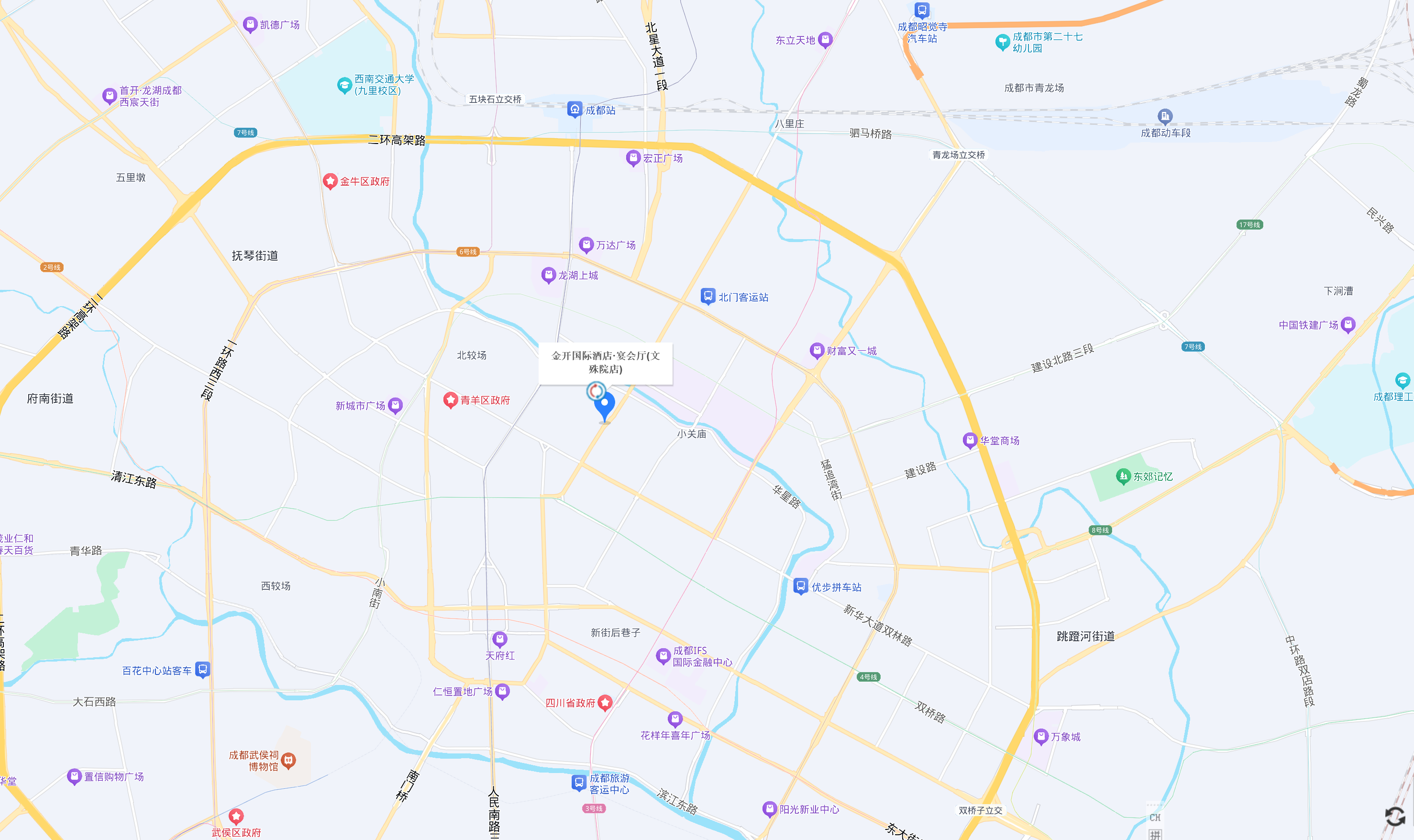
Jinkai International Convention Center (金开国际会议酒店)
Address:
No. 2 North Street, Caoshijie Street, Qingyang District, Chengdu (next to Wenshu Monastery) (成都市青羊区草市街街道北大街2号(文殊坊旁))
Hotel Description:
Jinkai International Convention Center is a high-end business and conference hotel located in the heart of Chengdu’s Qingyang District, adjacent to the renowned Wenshu Monastery and surrounded by rich cultural heritage. The hotel integrates accommodation, dining, and conference facilities, making it an ideal venue for business meetings, exhibitions, and leisure travel.
The hotel offers spacious and elegantly designed guest rooms equipped with modern amenities, ensuring guests enjoy both comfort and convenience. Its state-of-the-art convention halls are suitable for large-scale conferences and banquets, supported by professional event services.
How to Reach:
- From Chengdu Shuangliu International Airport: you can take a taxi (about 40 CNY, 40–50 min), or take Metro Line 19 at Taipingyuan Station(太平园站), transfer to Line 17 at Jiujiang North Station(九江北站), and get off at Chenghuang Tample Station (城隍庙站); from there, it’s about a 13-minute walk to the hotel (around 8 CNY, 60 min total).
- From Chengdu East Railway Station: you can take a taxi (about 30 CNY, 30 min), or take Metro Line 2 at Chengdu East Railway Station(成都东客站), transfer to Line 1 at Tianfu Square Station(天府广场站), and get off at Wenshu Monastery Station (文殊院站), then walk about 14 minutes to the hotel (around 6 CNY, 45 min total).
- From Chengdu Tianfu International Airport: you can take a taxi (about 100 CNY, 70-90 min), or take Metro Line 18 at Tianfu International Airport Station(天府国际机场站), transfer to Line 1 at South Railway Station(火车南站), and get off at Wenshu Monastery Station (文殊院站); from there, it’s about a 14-minute walk to the hotel (around 8 CNY, 90 min total).
Hotel Map:
Hotel Pictures:

TBD
About Chengdu Cuisine
Chengdu was designated as a UNESCO Creative City of Gastronomy on 28th February 2010. The designation is set to endorse the global recognition of Chengdu’s more than 2,000-year-old culinary legacy rooted in authentic Sichuanese cuisine. There is no better way to experience Chengdu’s unique gastronomy culture than by eating around the city, from world-class restaurants and iconic hotpot venues to time-honored street food stalls tucked away in nooks and crannies, to get a true taste of Chengdu.
Signature Flavors of Chengdu




Panda Charm Meets Chengdu Glamour
Chengdu Research Base of Giant Panda Breeding is a world-renowned base for ex-situ conservation of giant pandas and a cultural tourism destination. It is famous for protecting and breeding rare endemic wildlife unique to China, such as giant pandas and red pandas. With crystal-clear waters and harmonious birdsong, it is hailed as “a natural paradise for national treasures and a paradise on earth for us”.
Pandas



Brilliant Impressions of Chengdu